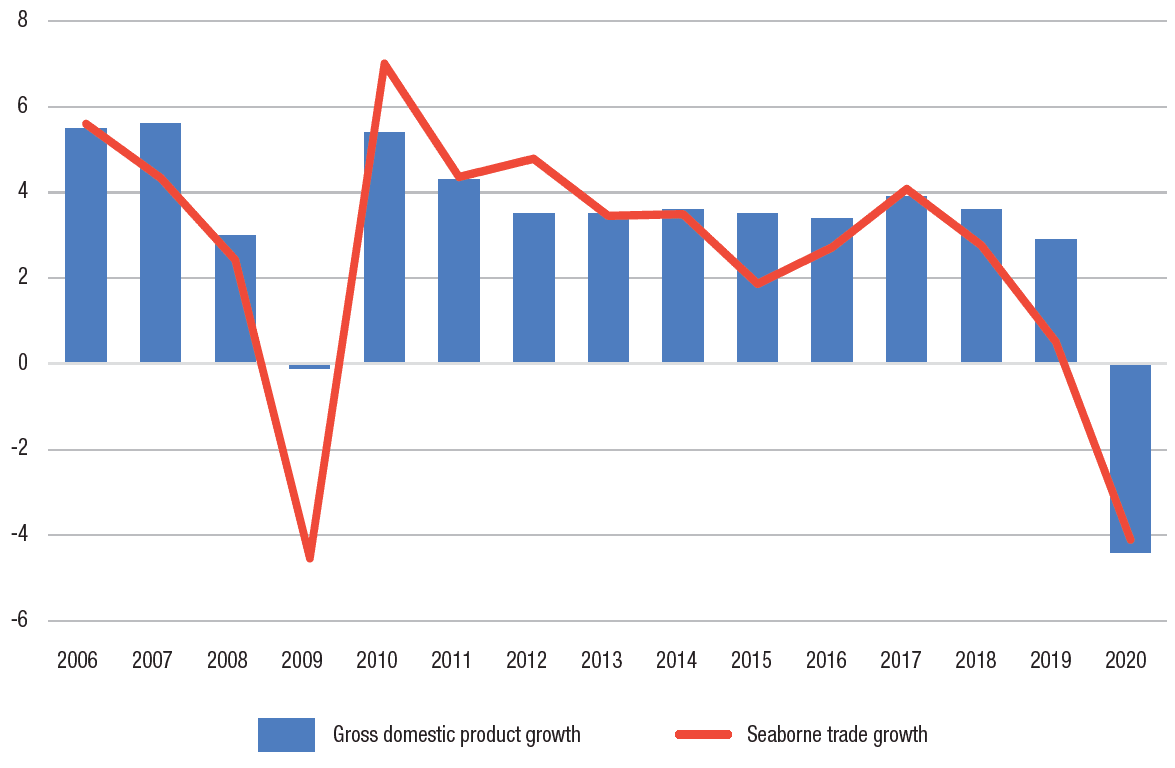
The pandemic has sent shockwaves through global maritime transport and laid the foundations for a transformed industry and associated supply chains. UNCTAD expects a return to growth in 2021.
Global maritime trade will plunge by 4.1% in 2020 due to the unprecedented disruption caused by COVID-19, UNCTAD estimates in its Review of Maritime Transport 2020, released on 12 November.
The report warns that new waves of the pandemic that further disrupt supply chains and economies might cause a steeper decline. The pandemic has sent shockwaves through supply chains, shipping networks and ports, leading to plummeting cargo volumes and foiling growth prospects, it says.
According to the report, the short-term outlook for maritime trade is grim. Predicting the pandemic’s longer-term impact as well as the timing and scale of the industry’s recovery is fraught with uncertainty.
“The global shipping industry will be at the forefront of efforts towards a sustainable recovery, as a vital enabler of the smooth functioning of international supply chains,” UNCTAD Secretary-General Mukhisa Kituyi said. “The industry must be a key stakeholder helping adapt ‘just-in-time efficiency’ logistics to ‘just-in-case’ preparedness,” he added.
UNCTAD expects maritime trade growth to return to a positive territory and expand by 4.8% in 2021, assuming world economic output recovers. But it highlights the need for the maritime transport industry to brace for change and be well prepared for a transformed post-COVID-19 world.
Responses to the pandemic
At the peak of the crisis, when the contraction of cargo volumes brought an additional challenge to structural market imbalance, the report notes, the container shipping industry adopted more discipline, cutting capacity and reducing costs to maintain profitability instead of market share.
As a result, freight rates remained at stable levels despite the depressed demand. From the perspective of shippers, these strategies meant severe space limitations to transport goods and delays in delivery dates.
To cope with pandemic-related disruptions, players in the maritime sector adjusted their operations, finances, sanitary and safety protocols as well as working practices and procedures.
In addition, several governments, through their border agencies, port authorities and customs administrations, made reforms to keep trade flowing while keeping people safe.
“Border agents, port workers and customs officials play an essential role in keeping trade moving, helping us to navigate through the crisis,” Dr. Kituyi said. “It will be important to assess the best practices that emerge from their experiences to strengthen trade facilitation in the years to come.”
Whither globalization, decarbonization? . . .
. . . continue reading the Report on the UNCTAD website here
About UNCTAD
Globalization, including a phenomenal expansion of trade, has helped lift millions out of poverty. But not nearly enough people have benefited. And tremendous challenges remain.
We support developing countries to access the benefits of a globalized economy more fairly and effectively. And we help equip them to deal with the potential drawbacks of greater economic integration. To do this, we provide analysis, facilitate consensus-building, and offer technical assistance. This helps them to use trade, investment, finance, and technology as vehicles for inclusive and sustainable development.
Working at the national, regional, and global level, our efforts help countries to:
Comprehend options to address macro-level development challenges
Achieve beneficial integration into the international trading system
Diversify economies to make them less dependent on commodities
Limit their exposure to financial volatility and debt
Attract investment and make it more development friendly
Increase access to digital technologies
Promote entrepreneurship and innovation
Help local firms move up value chains
Speed up the flow of goods across borders
Protect consumers from abuse
Curb regulations that stifle competition
Adapt to climate change and use natural resources more effectively
Together with other UN departments and agencies, we measure progress by the Sustainable Development Goals, as set out in Agenda 2030.
We also support implementation of Financing for Development, as mandated by the global community in the 2015 Addis Ababa Agenda, together with four other major institutional stakeholders: the World Bank, the International Monetary Fund, the World Trade Organization, and the United Nations Development Programme.
While we work mainly with governments, to effectively deal with the magnitude and complexity of meeting the Sustainable Development Goals, we believe that partnerships and closer cooperation with the private sector and civil society are essential.
Ultimately, we are serving the citizens of the 195 countries that make up our organization. Our goal is prosperity for all.